Football Free Kick with Physics - Calculate and try to score a goal
How rotational spin and air density interact to generate lift and curve via the Magnus Effect.
About This Simulation
When a soccer ball is kicked with spin, its flight trajectory curves in the direction of the spin. This lateral movement is caused by the Magnus Effect, a physical phenomenon where a spinning object curves away from its principal flight path due to pressure differences created by air flow on opposite sides of the ball.
Whether studying classical fluid dynamics or watching a World Cup free kick, the Magnus Effect explains why soccer balls, tennis balls, and baseballs curve. By curving the ball, players can bypass a wall of defenders and curve the ball into the top corner of the goal net.
Mathematical & Physics Concepts
1Bernoulli Principle & Boundary Layers
As the ball spins, it drags a thin layer of air (boundary layer) around with it. On one side of the ball, this rotation aligns with the oncoming airflow, speeding it up. On the opposite side, the spin opposes the airflow, slowing it down.
•Higher air speed creates a low-pressure region (Bernoulli's principle).
•Lower air speed creates a high-pressure region.
•The pressure difference creates a net force pushing the ball toward the low-pressure side.
2Magnus Force Equation
The force is mathematically modeled using the cross product of the angular velocity vector and the linear velocity vector.
•Formula: F_M = C_L * rho * A * v * r * omega
•Higher air density (rho) at sea level yields more curve than at high-altitude stadiums.
3Aerodynamic Drag and Turbulent Flow
As the ball moves through air, it encounters resistance (drag). At high speeds, the flow is turbulent, reducing the drag coefficient. As the ball slows down, it enters laminar flow, which increases drag and can cause the ball to curve even more sharply at the end of its flight.
•Drag opposes velocity and is proportional to the square of speed.
•Roughness on the ball surface (seams) can trigger turbulent flow earlier, altering the curve.
Worked Solutions
Example 1: Calculating Magnus Force
Problem: Calculate the lateral Magnus force on a soccer ball (mass = 0.43 kg, radius = 0.11 m) travelling at 25 m/s with a sidespin of 600 RPM (omega = 62.8 rad/s) in air density of 1.2 kg/m^3. Assume lift coefficient C_L = 0.2.
Step-by-step Solution:
- 1Convert sidespin to radians per second: 600 RPM * (2 * pi / 60) = 62.83 rad/s.
- 2Calculate the cross-sectional area: A = pi * r^2 = pi * (0.11)^2 = 0.038 m^2.
- 3Apply the Magnus force formula: F_M = 0.5 * C_L * rho * A * v * r * omega.
- 4Substitute: F_M = 0.5 * 0.2 * 1.2 * 0.038 * 25 * 0.11 * 62.83 = 0.098 N.
- 5This lateral force accelerates the 0.43 kg ball sideways.
Key Equations
Magnus Force Vector Relation
F_M is the Magnus force vector, omega is the angular velocity (spin vector), v is the linear velocity, and S is the aerodynamic spin coefficient.
Aerodynamic Drag Force
Opposes the direction of motion. C_d is the drag coefficient, rho is the air density, and A is the cross-sectional area.
Key Takeaways
- •Magnus force is perpendicular to both the velocity vector and the spin axis vector of the ball.
- •Faster rotation (RPM) and higher air density increase the magnitude of the curving force.
- •The famous 1997 free kick by Roberto Carlos against France is a classic real-world manifestation of the Magnus force combined with drag reduction.
Topic FAQ
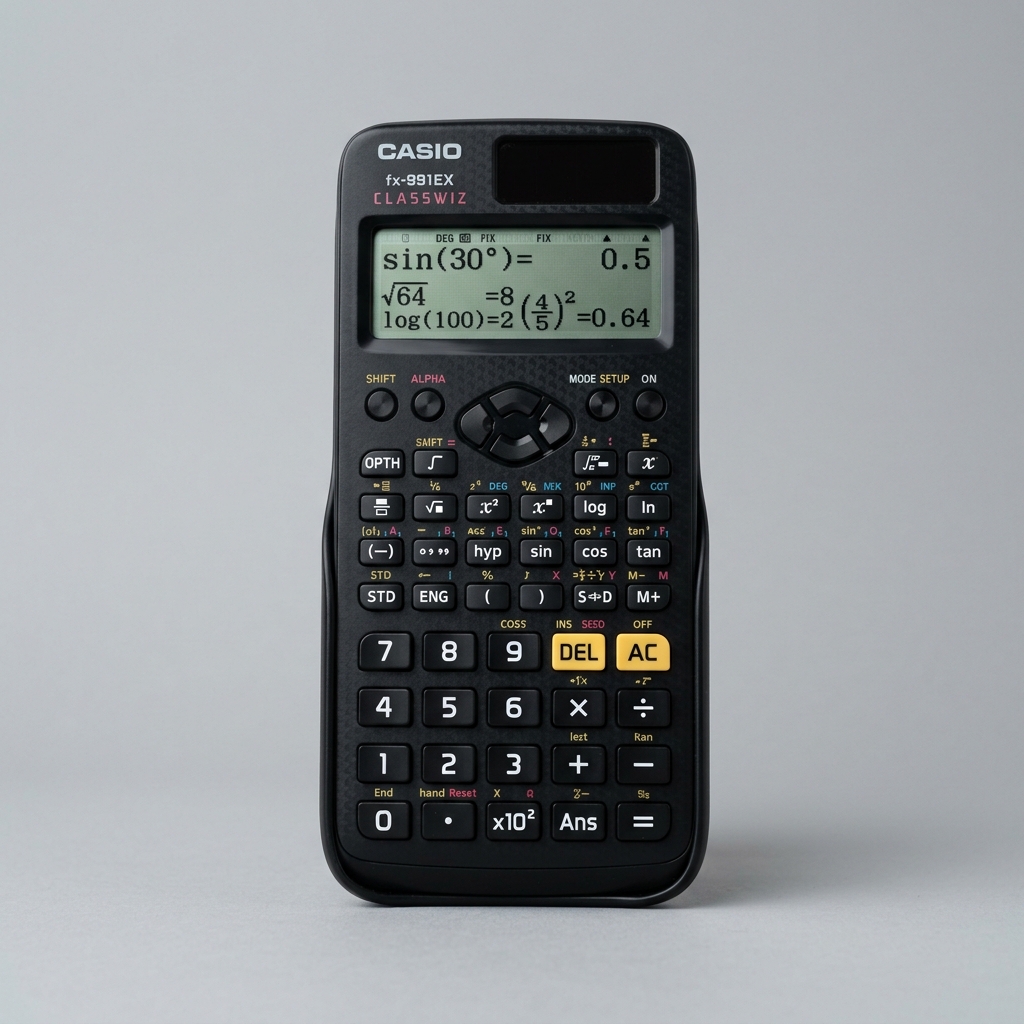
The #1 recommended scientific calculator for board exams, math, and physics.
Practice Quiz & Interactive Assessment
Syllabus Review Mode
0 🔥
0 in a row