The Ultimate Guide to Ratios and Proportions: Formulas, Simplification, and Examples
The Ultimate Guide to Ratios and Proportions: Formulas, Simplification, and Examples
Learn how to express, simplify, and solve ratios and proportions. This comprehensive guide covers part-to-part and part-to-whole ratios with practical math steps.
In mathematics and daily life, we frequently compare sizes, speeds, prices, and quantities. The most efficient tools for these comparisons are ratios and proportions. A ratio is a mathematical comparison of two or more numbers, while a proportion is an equation stating that two ratios are equal. Understanding this math is essential for everything from cooking recipes to engineering blueprints.
1. What is a Ratio and How is it Written?
A ratio compares the relative sizes of two values. It tells you how much of one thing there is compared to another. For example, if a bag contains 8 red marbles and 4 blue marbles, the ratio of red to blue is 8 to 4. We can write this comparison in three standard ways:
- With a colon (Colon Form): 8:4
- As a fraction (Fraction Form): 8/4
- With words (Word Form): 8 to 4
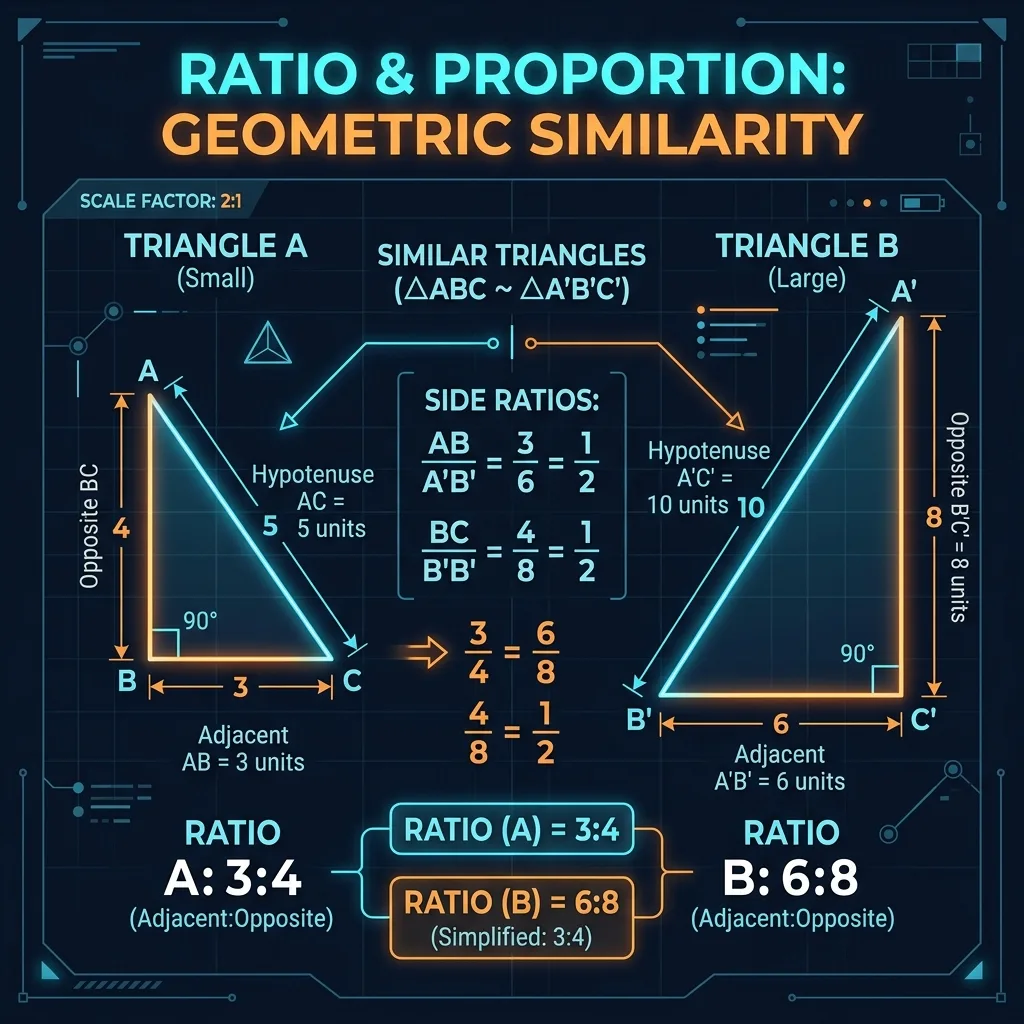
Figure 1: Labeled comparison of proportional right-angled triangles showing equivalent side ratios (3:4 vs 6:8).
Ratios can represent part-to-part relationships (comparing red marbles to blue marbles) or part-to-whole relationships (comparing red marbles to the total marbles in the bag).
2. How to Simplify a Ratio Step-by-Step
Just like fractions, ratios are easiest to understand in their simplest form. To simplify a ratio, find the Greatest Common Divisor (GCD) of the terms and divide each term by that number. For the ratio 8:4, the GCD of 8 and 4 is 4. Dividing both sides by 4 yields the simplified ratio 2:1.
3. Understanding Proportions: Solving for X
A proportion states that two ratios are equivalent. For example, the ratio 1:2 is proportional to 5:10. When one value in a proportion is unknown, we can use algebra to solve for it (often called solving for X). The most common method to solve proportions is cross-multiplication.
4. Real-World Applications of Ratios and Proportions
Ratios and proportions appear in everyday activities more than you might realize:
- Scaling Recipes: If a recipe for 4 people requires 2 cups of flour, what is the ratio? It is 2:4 (or 1:2). If you need to cook for 10 people, you set up the proportion: 1/2 = X/10. Cross-multiplying gives 2 × X = 10, meaning X = 5 cups of flour.
- Aspect Ratios (Screens & TV): Modern widescreen displays use a 16:9 aspect ratio. If a screen width is 1920 pixels, what is the height? Solve the proportion: 16/9 = 1920/H. Cross-multiplying gives 16 × H = 17280, meaning H = 1080 pixels (Full HD).
- Map Scaling: A map scale of 1:50,000 indicates that 1 centimeter on the map represents 50,000 centimeters (500 meters) in the physical world.
Ready to calculate some ratios? Scroll down to the interactive Ratio & Proportion Calculator below, input your values, and solve for the missing term instantly with step-by-step visual results!
Interactive Inline Calculator
Adjust target values below to run formulas in real-time instantly.
Adjust Inputs
Calculated Results
Student Solver & Visualizer Guide
Real-time calculationsStep-by-step solving
Student-friendly explanations
Visual explanations
A: [████] (4)
B: [██████] (6)

Target proportion:
Target A: [████████████] (12)
Target B: [██████████████████] (18)
Join 10,000+ Students
Get our weekly Band 7+ IELTS vocabulary cheat sheet and exam strategies delivered straight to your inbox.
Recommended Tools & Lessons
Ratio Calculator
Simplify given ratios to their simplest form, or solve for missing variables to compute equivalent proportions.
Understanding CSS Units: Why You Should Convert PX to REM for Responsive Spacing
Learn the difference between absolute (px) and relative (rem) CSS units. Discover why converting pixels to rem is crucial for modern, accessible web design.
Binary and Hexadecimal Systems: A Developer Guide to Computer Mathematics
Demystify how computers represent numbers. Master conversions between binary, octal, decimal, and hexadecimal with step-by-step algorithms.
English Grammar Rules for IELTS 2026: The 12 Rules That Most Affect Your Band Score
Master the 12 critical English grammar rules for IELTS 2026. Learn to build grammatical range, avoid common sentence errors, and secure a Band 7+ score.
IELTS Band 7 Vocabulary List 2026: 120 Words That Actually Raise Your Score
Ditch basic words for Band 7+ vocabulary. This guide provides 120 high-value academic IELTS words across education, technology, and environment with collocations.