How to Solve Trigonometry and Pythagorean Theorem Problems
How to Solve Trigonometry and Pythagorean Theorem Problems
A complete guide to right-triangle geometry. Discover how to calculate missing side lengths and angles using the Pythagorean formula and trigonometric ratios (sin, cos, tan).
In geometry and everyday applications—from architecture and navigation to physics and game design—right-angled triangles are fundamental. A right triangle has one angle measuring exactly 90 degrees. To solve for missing side lengths and angles in these shapes, mathematicians rely on two powerful sets of tools: the Pythagorean Theorem and Trigonometric Ratios (sine, cosine, tangent).
1. The Pythagorean Theorem: Sides of a Triangle
The Pythagorean Theorem describes the relation between the three sides of a right triangle. It states that the square of the hypotenuse (the longest side opposite the right angle) is equal to the sum of the squares of the other two sides (the legs). The formula is written as:
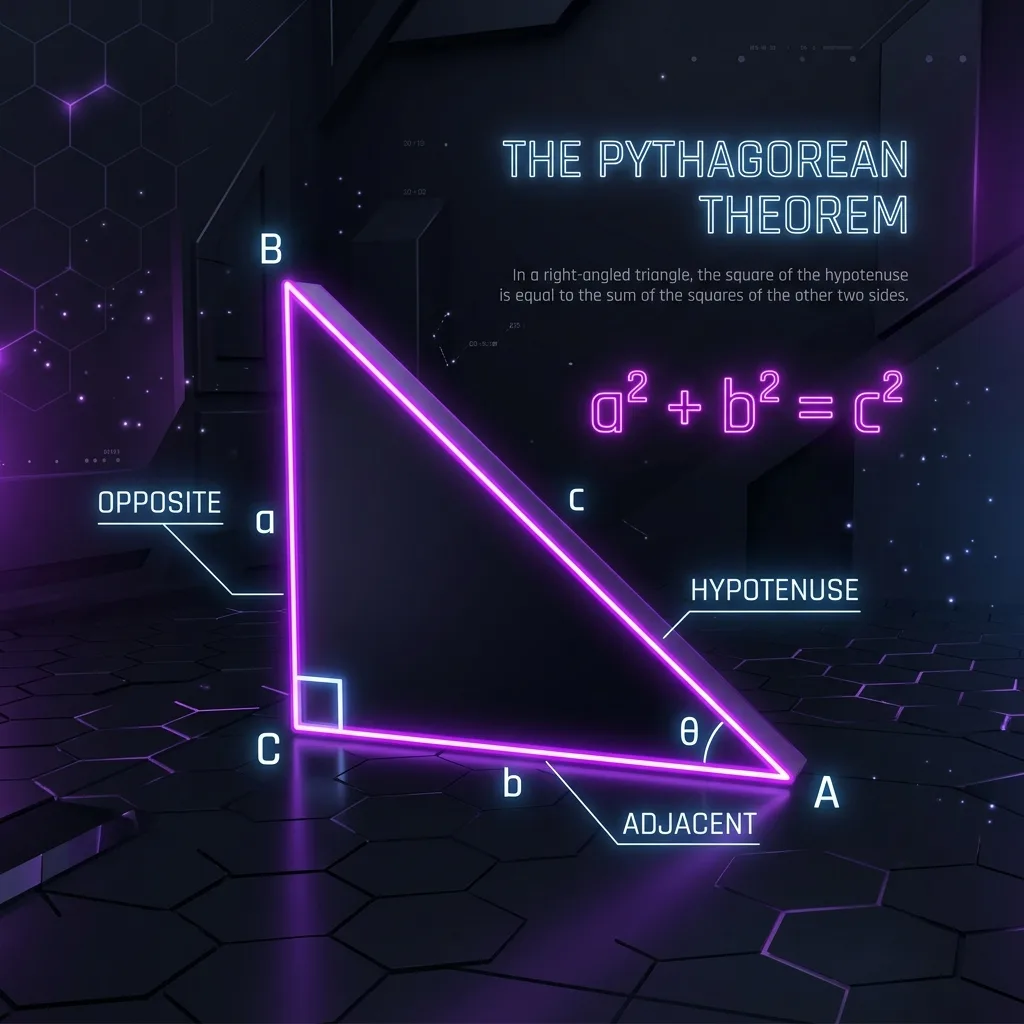
Figure 2: Diagram of a right-angled triangle showing opposite, adjacent, and hypotenuse relative to angle theta (θ).
If you know any two side lengths of a right triangle, you can rearrange this equation to find the third side length.
2. Trigonometric Ratios: Sine, Cosine, and Tangent
While the Pythagorean Theorem works purely with side lengths, trigonometry links side lengths with angles. The three primary trigonometric ratios—Sine (sin), Cosine (cos), and Tangent (tan)—are calculated relative to an acute angle (represented by the Greek letter theta, θ). You can remember them using the SOH-CAH-TOA mnemonic:
- SOH: Sine = Opposite / Hypotenuse (sin(θ) = opp / hyp)
- CAH: Cosine = Adjacent / Hypotenuse (cos(θ) = adj / hyp)
- TOA: Tangent = Opposite / Adjacent (tan(θ) = opp / adj)
The opposite side is directly across from angle θ, the adjacent side is next to angle θ (but is not the hypotenuse), and the hypotenuse is always the longest side opposite the 90-degree angle.
3. Step-by-Step Triangle Calculations
Let us look at some practical geometry examples to see how these equations are applied in real life.
- Example 1: Finding a Side Length (Pythagoras). A right triangle has legs of length 3 cm and 4 cm. What is the hypotenuse? Solve: c² = 3² + 4² = 9 + 16 = 25. Taking the square root gives c = 5 cm.
- Example 2: Finding an Angle (Trigonometry). A 10-foot ladder rests against a wall, with its base 6 feet away from the wall. What angle does the ladder make with the ground? The 10-foot ladder is the hypotenuse and the 6-foot distance is the adjacent side. Solve: cos(θ) = 6 / 10 = 0.6. Thus, θ = arccos(0.6) ≈ 53.13 degrees.
- Example 3: Finding a Height (Trigonometry). A surveyor measures the angle of elevation to a building's top as 30 degrees from 100 meters away. Find the building's height: tan(30°) = Height / 100. Height = 100 × tan(30°) ≈ 100 × 0.577 = 57.7 meters.
Ready to solve your own right-triangle problems? Scroll down to the interactive Trigonometry Calculator and Pythagorean Theorem Calculator below, input your known sides or angles, and see the solved values instantly with step-by-step solutions!
Interactive Inline Calculator
Adjust target values below to run formulas in real-time instantly.
Adjust Inputs
Calculated Results
Student Solver & Visualizer Guide
Real-time calculationsStep-by-step solving
Student-friendly explanations
Visual explanations
MATH SOLVER RUNNING:
 [Inputs] ──► [Mathematical Formula] ──► [Outputs]
  Processed elements successfully.
Join 10,000+ Students
Get our weekly Band 7+ IELTS vocabulary cheat sheet and exam strategies delivered straight to your inbox.
Recommended Tools & Lessons
Trigonometry Calculator
Solve trigonometric values (sin, cos, tan, cosec, sec, cot) for degrees or radian structures.
Understanding CSS Units: Why You Should Convert PX to REM for Responsive Spacing
Learn the difference between absolute (px) and relative (rem) CSS units. Discover why converting pixels to rem is crucial for modern, accessible web design.
Binary and Hexadecimal Systems: A Developer Guide to Computer Mathematics
Demystify how computers represent numbers. Master conversions between binary, octal, decimal, and hexadecimal with step-by-step algorithms.
English Grammar Rules for IELTS 2026: The 12 Rules That Most Affect Your Band Score
Master the 12 critical English grammar rules for IELTS 2026. Learn to build grammatical range, avoid common sentence errors, and secure a Band 7+ score.
IELTS Band 7 Vocabulary List 2026: 120 Words That Actually Raise Your Score
Ditch basic words for Band 7+ vocabulary. This guide provides 120 high-value academic IELTS words across education, technology, and environment with collocations.