Chapter 10: Three Dimensional Geometry
Standard NCERT & CBSE aligned study curriculum. Master concepts, track accuracy, revise weak areas, and challenge yourself with 9 customized practice modes.
Syllabus Sections
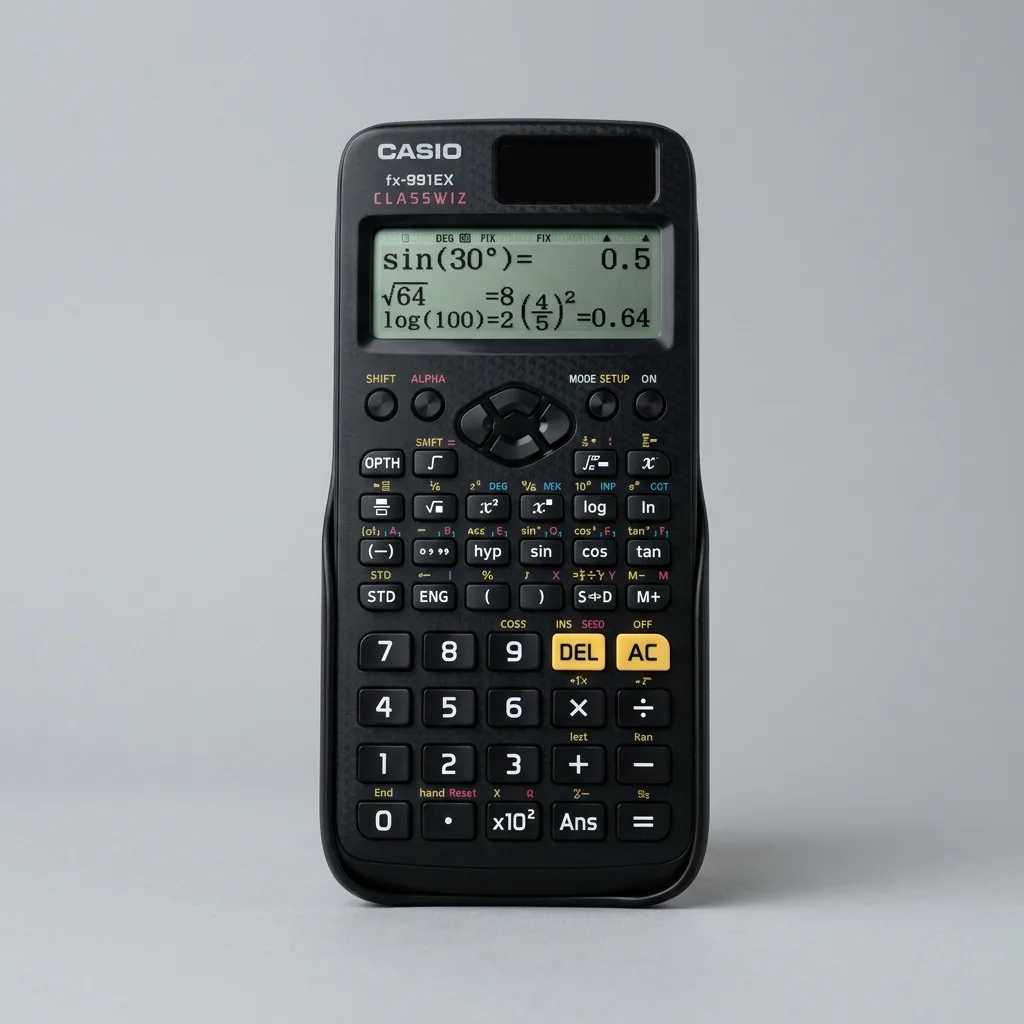
The #1 recommended scientific calculator for board exams, math, and physics.
As an Amazon Associate we earn from qualifying purchases.
Chapter Overview
Welcome to Class XII Mathematics: Three Dimensional Geometry. This chapter forms a core structural component of the math syllabus, designed to build analytical rigor and key formula models.
Use the detailed subtopic guide below to review standard definitions, key mathematical rules, and study guidelines.
Prerequisite Concepts
About This Chapter
This comprehensive study guide for Three Dimensional Geometry is designed for Class XII students following the CBSE and NCERT Mathematics curriculum. It covers 5 key subtopics including Direction cosines and direction ratios of a line, Vector and Cartesian equations of a line in space, Angle between two lines, and 2 more essential concepts. Whether you are preparing for school examinations, CBSE board exams, or competitive tests, this resource provides everything you need to build a strong conceptual foundation and achieve mastery.
The chapter includes 2 key formulas and equations, 1 fully worked step-by-step example problems, interactive practice exercises across 9 difficulty categories, timed mock quizzes, and downloadable worksheets. Each topic is explained with detailed concept definitions, mathematical representations, and expert study guidelines to help you understand not just the "how" but the "why" behind every formula and method.
Mathematics is a subject that rewards consistent practice and conceptual clarity over rote memorization. As you work through this chapter on Three Dimensional Geometry, focus on understanding the underlying principles first, then gradually increase problem difficulty. Use the practice sections to identify and strengthen weak areas, and refer to the common mistakes section to avoid the pitfalls that most students encounter.
What You'll Learn in This Chapter
By the end of studying Three Dimensional Geometry for Class XII, you will have developed proficiency in the following learning outcomes as outlined by the NCERT syllabus:
Convert line equations between vector and Cartesian formats.
Calculate shortest distance between skew lines in 3D.
Calculate angles between intersecting lines.
Prerequisites for This Chapter
Before studying Three Dimensional Geometry, make sure you are comfortable with the following prerequisite concepts. A strong foundation in these areas will help you understand new topics faster and solve problems more confidently:
If any of these prerequisites feel unfamiliar, consider reviewing them first using the Related Chapters section at the bottom of this page. Building a solid base ensures you can tackle Three Dimensional Geometry with full confidence.
Real-World Applications of Three Dimensional Geometry
Students often wonder “Where will I use Three Dimensional Geometryin real life?” The answer is: everywhere. The mathematical concepts you learn in this chapter have practical applications across science, engineering, technology, medicine, finance, and everyday problem-solving. Here are some notable examples:
Architecture & CAD Design
Architects use 3D coordinate geometry in CAD software to design buildings, calculate distances, and verify structural alignments.
Robotics & Drone Navigation
Autonomous robots and drones navigate 3D space using coordinate geometry to plan paths and avoid obstacles.
Medical 3D Imaging
MRI and CT machines create 3D body images using coordinate geometry to map tissue density at every point in space.
Virtual Reality
VR headsets track head position and orientation in 3D space using coordinate transformations for immersive experiences.
Understanding the real-world relevance of Three Dimensional Geometry not only makes learning more engaging but also helps you appreciate how mathematical thinking is a superpower that opens doors in virtually every career path — from engineering and medicine to finance and technology.
Study Tips for Three Dimensional Geometry
Follow these expert study strategies to maximize your understanding and exam performance in this chapter. These tips are specifically tailored for the type of content covered in Three Dimensional Geometry:
Master the Standard Value Table
Create a table of sin, cos, and tan values for 0°, 30°, 45°, 60°, and 90° and practice until you can recall them instantly. These values appear in almost every trigonometry problem.
Use ASTC Quadrant Rule
Remember "All Students Take Coffee" — All trig functions are positive in Q1, only Sine in Q2, only Tangent in Q3, only Cosine in Q4. This prevents sign errors in angle calculations.
Practice Identity Proofs Separately
Trigonometric identity proofs require a different skill set from numerical problems. Practice them separately, always working from the more complex side toward the simpler side.
Pro Tip: Consistency beats intensity. Studying Three Dimensional Geometry for 30 minutes daily is far more effective than cramming for 5 hours before the exam. Use the practice sections below to build muscle memory through regular problem-solving.
Detailed Subtopics Study Guide
Review detailed conceptual explanations, mathematical equations, and guidelines for each subtopic in this chapter:
1Direction cosines and direction ratios of a line
Concept Explanation
The direction cosines (l, m, n) of a line are the cosines of the angles it makes with the coordinate axes. Direction ratios (a, b, c) are any numbers proportional to the direction cosines.
Mathematical Representation
2Vector and Cartesian equations of a line in space
Concept Explanation
A straight line in space can be defined by a point it passes through and its direction vector. It is represented in vector form or Cartesian form.
Mathematical Representation
3Angle between two lines
Concept Explanation
The angle θ between two lines in space is the angle between their direction vectors, calculated using the dot product of their directions.
Mathematical Representation
4Shortest distance between two lines (skew lines)
Concept Explanation
Skew lines are lines in space that are not parallel and do not intersect. The shortest distance between them is measured along their common perpendicular line.
Mathematical Representation
5Distance of a point from a plane
Concept Explanation
The perpendicular distance from a point P(x1, y1, z1) to a plane Ax + By + Cz + D = 0 is calculated using a standard coordinate formula.