Chapter 6: Permutations and Combinations
Standard NCERT & CBSE aligned study curriculum. Master concepts, track accuracy, revise weak areas, and challenge yourself with 9 customized practice modes.
Syllabus Sections
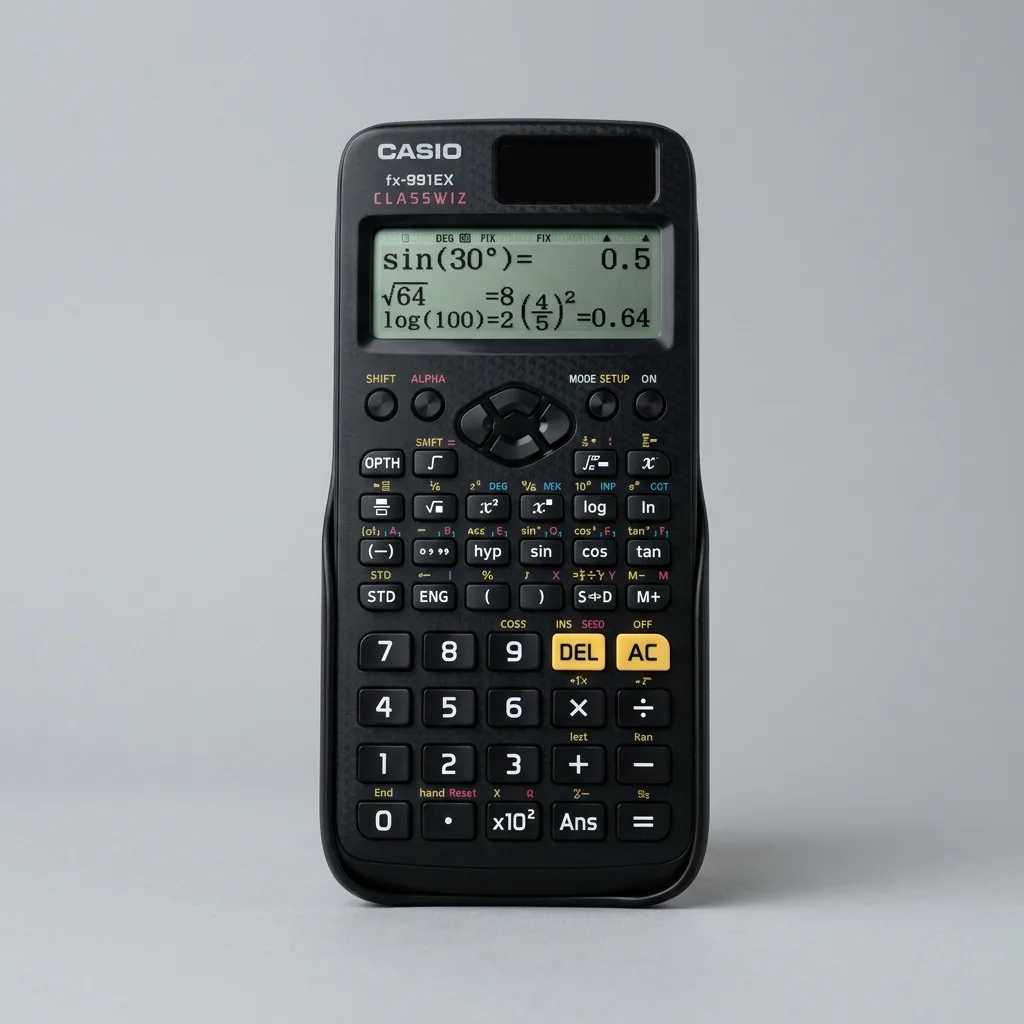
The #1 recommended scientific calculator for board exams, math, and physics.
As an Amazon Associate we earn from qualifying purchases.
Chapter Overview
Welcome to Class XI Mathematics: Permutations and Combinations. This chapter forms a core structural component of the math syllabus, designed to build analytical rigor and key formula models.
Use the detailed subtopic guide below to review standard definitions, key mathematical rules, and study guidelines.
Prerequisite Concepts
About This Chapter
This comprehensive study guide for Permutations and Combinations is designed for Class XI students following the CBSE and NCERT Mathematics curriculum. It covers 5 key subtopics including Fundamental principle of counting, Factorial notation, Permutations formula nPr, and 2 more essential concepts. Whether you are preparing for school examinations, CBSE board exams, or competitive tests, this resource provides everything you need to build a strong conceptual foundation and achieve mastery.
The chapter includes 2 key formulas and equations, 1 fully worked step-by-step example problems, interactive practice exercises across 9 difficulty categories, timed mock quizzes, and downloadable worksheets. Each topic is explained with detailed concept definitions, mathematical representations, and expert study guidelines to help you understand not just the "how" but the "why" behind every formula and method.
Mathematics is a subject that rewards consistent practice and conceptual clarity over rote memorization. As you work through this chapter on Permutations and Combinations, focus on understanding the underlying principles first, then gradually increase problem difficulty. Use the practice sections to identify and strengthen weak areas, and refer to the common mistakes section to avoid the pitfalls that most students encounter.
What You'll Learn in This Chapter
By the end of studying Permutations and Combinations for Class XI, you will have developed proficiency in the following learning outcomes as outlined by the NCERT syllabus:
Evaluate counting tasks using multiplication and addition principles.
Differentiate between permutations (order matters) and combinations (order doesn't matter).
Solve arrangement and selection word puzzles.
Prerequisites for This Chapter
Before studying Permutations and Combinations, make sure you are comfortable with the following prerequisite concepts. A strong foundation in these areas will help you understand new topics faster and solve problems more confidently:
If any of these prerequisites feel unfamiliar, consider reviewing them first using the Related Chapters section at the bottom of this page. Building a solid base ensures you can tackle Permutations and Combinations with full confidence.
Real-World Applications of Permutations and Combinations
Students often wonder “Where will I use Permutations and Combinationsin real life?” The answer is: everywhere. The mathematical concepts you learn in this chapter have practical applications across science, engineering, technology, medicine, finance, and everyday problem-solving. Here are some notable examples:
Password & Pin Security
The number of possible password combinations determines security strength — a 4-digit PIN has 10â´ = 10,000 permutations.
Tournament Scheduling
Sports organizers use combinations to determine the total number of matches when every team plays against every other team.
Lottery & Gaming Odds
Lottery odds are calculated using combination formulas — choosing 6 numbers from 49 gives â´â¹C₆ = 13,983,816 possible outcomes.
Seating Arrangements
Event planners calculate possible seating arrangements for guests at circular or linear tables using permutation formulas.
Understanding the real-world relevance of Permutations and Combinations not only makes learning more engaging but also helps you appreciate how mathematical thinking is a superpower that opens doors in virtually every career path — from engineering and medicine to finance and technology.
Study Tips for Permutations and Combinations
Follow these expert study strategies to maximize your understanding and exam performance in this chapter. These tips are specifically tailored for the type of content covered in Permutations and Combinations:
Create Mind Maps
Draw concept maps connecting definitions, properties, and theorems visually. Abstract chapters have many interconnected ideas, and mind maps help you see the big picture and recall relationships during exams.
Use Concrete Examples
For every abstract definition, create a specific numerical example. For instance, when learning about injective functions, write down f(x) = 2x+1 and verify injectivity with actual numbers.
Connect to Real Applications
Abstract concepts become memorable when linked to real-world applications. Sets relate to database queries, matrices to image transformations, permutations to password security.
Pro Tip: Consistency beats intensity. Studying Permutations and Combinations for 30 minutes daily is far more effective than cramming for 5 hours before the exam. Use the practice sections below to build muscle memory through regular problem-solving.
Detailed Subtopics Study Guide
Review detailed conceptual explanations, mathematical equations, and guidelines for each subtopic in this chapter:
1Fundamental principle of counting
Concept Explanation
The fundamental principle of counting states that if one event can occur in 'm' ways, and a second event can occur in 'n' ways, then the two events in succession can occur in m x n ways (Multiplication Principle) or m + n ways if they are mutually exclusive (Addition Principle).
Mathematical Representation
2Factorial notation
Concept Explanation
For a positive integer n, factorial (n!) is the product of all positive integers less than or equal to n. By definition, 0! is equal to 1.
Mathematical Representation
3Permutations formula nPr
Concept Explanation
A permutation is an ordered arrangement of a set of objects. The number of permutations of n distinct objects taken r at a time is denoted as nPr.
Mathematical Representation
4Combinations formula nCr
Concept Explanation
A combination is a selection of objects where the order does not matter. The number of combinations of n distinct objects taken r at a time is denoted as nCr.
Mathematical Representation
5Simple applications
Concept Explanation
Practical applications of permutations and combinations include finding the number of diagonals in a polygon, the number of handshakes in a room, or word arrangements under specific constraints (e.g., vowels together).