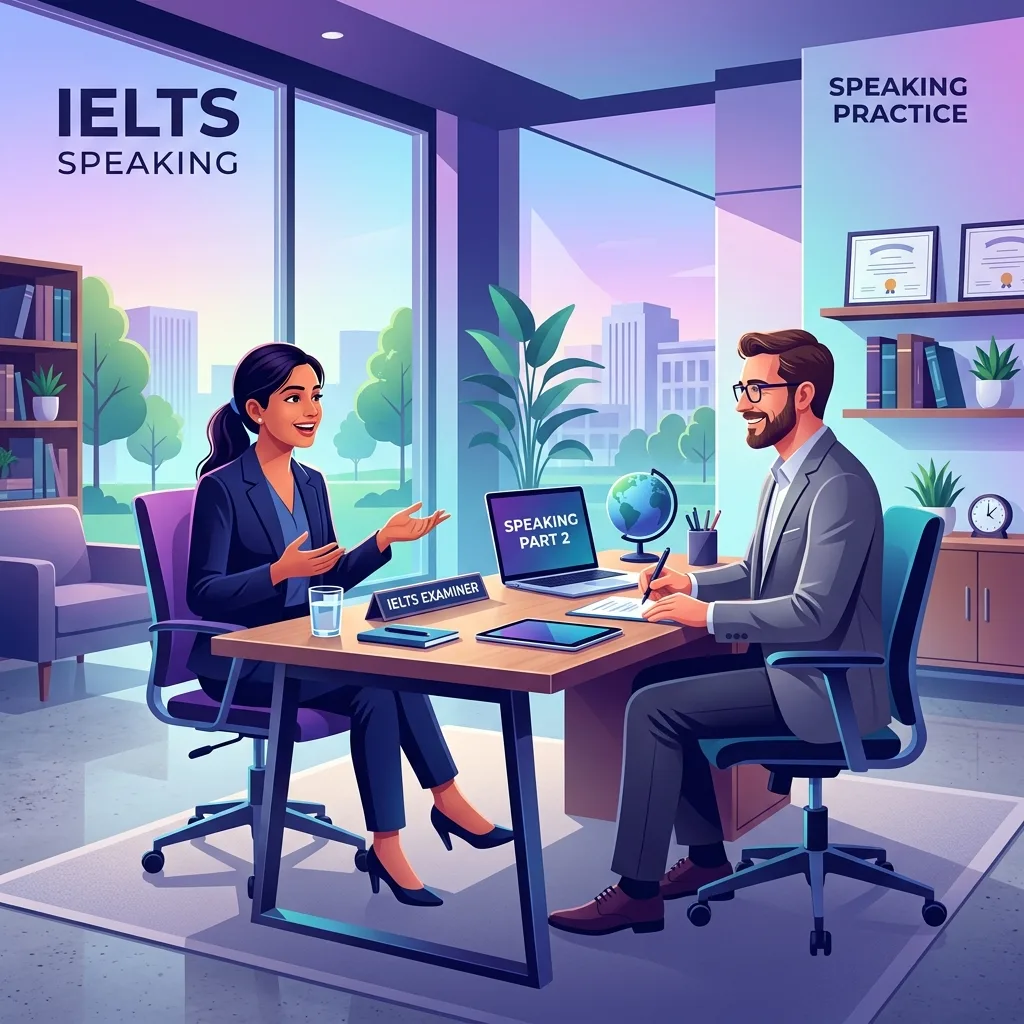
IELTS Speaking Part 2 — the "Long Turn" — is the section where most Indian test-takers lose the most marks they didn't need to lose. Not because their English is poor, but because they run out of things to say after 60 seconds, or they memorise model answers word-for-word and sound robotic, or they spend their 1-minute preparation time panicking instead of planning.
This guide gives you the 10 most frequently reported cue card topics from 2026 Indian test centres, the exact structure that takes you through a full 2 minutes confidently, the vocabulary that signals Band 7+ to examiners, and the preparation method that actually works.
Practice speaking on these topics using NexPro's IELTS Speaking Portal — IELTS Part 1, 2 and 3 question banks with model answers and band descriptors.
What Part 2 Actually Tests
Part 2 lasts 3–4 minutes. The examiner gives you a cue card with a topic and 3–4 bullet points. You get exactly 1 minute to prepare (pencil and paper provided), then you speak for 1–2 minutes. The examiner will stop you at 2 minutes. After your talk, the examiner asks 1–2 follow-up questions.
Your response is scored on four equally weighted criteria:
| Criterion | What it means at Band 7 |
|---|---|
| Fluency & Coherence | Speaks at length without long pauses; ideas flow logically |
| Lexical Resource | Uses topic-specific vocabulary naturally and accurately |
| Grammatical Range | Uses a mix of simple and complex sentence structures |
| Pronunciation | Clear enough to be understood throughout; consistent |
Accent does not affect your score. A strong Indian accent is perfectly fine as long as your speech is clear and consistent. Examiners are trained explicitly on this point.
The Biggest Mistake: Memorising Model Answers
Examiners are trained to detect memorised responses. A memorised answer sounds fluent and polished for the first 15 seconds, then falls apart because the student cannot adapt to the specific wording of the cue card. Detected memorisation results in a Fluency penalty.
The correct approach: Memorise structures and vocabulary, not sentences. Prepare a flexible framework that you can apply to any topic, and fill it with your own genuine experiences.
The 1-Minute Preparation Strategy
- Second 1–10: Read the cue card fully. Identify the topic and all bullet points.
- Second 10–30: Choose a specific story or experience. Vague answers ("I went somewhere nice") score lower than specific ones ("I visited Hampi in Karnataka in December 2024 with my college friends"). Specific details make you sound natural, not memorised.
- Second 30–50: Write 4–5 keywords on your paper — one per bullet point. Do not write full sentences. Keywords: Who? When? Where? What happened? How did you feel?
- Second 50–60: Plan your opening sentence. Candidates who have a strong first sentence speak more fluently from the start.
The Universal Cue Card Structure (Works for Any Topic)
All Part 2 topics — whether about a person, place, object, experience, or event — can be answered using this four-part structure:
- Part 1 — Introduction (15–20 seconds): Directly address the main topic. Who/what/where/when. E.g. "I'd like to talk about... This was/is..."
- Part 2 — Description (40–50 seconds): Cover the bullet points. Add specific details — names, places, times, numbers. E.g. "To describe it in more detail... What really stood out was... One thing I particularly remember is..."
- Part 3 — Personal Response (20–25 seconds): Why was this significant to you? How did it make you feel? What did you learn? E.g. "What made this particularly special was... Looking back, I think... This experience taught me..."
- Part 4 — Rounding off (10–15 seconds): A brief concluding statement. Do not just stop speaking — signal that you are finishing. E.g. "Overall, this is something I look back on very fondly / something I would definitely recommend / an experience that changed the way I think about..."
The 10 Most Reported Cue Card Topics — India 2026
Based on reported test experiences from Indian test centres between January and June 2026, these are the topics appearing most frequently. Study the structure of each model answer — then prepare your own version using a personal experience.
Cue Card 1 — Describe a person who has inspired you
Prompt: Describe a person who has had a significant influence on your life. You should say: who this person is / how you know them / what they do or have done / and explain why they have influenced you.
"The person who has influenced me most is my Class 12 English teacher, Mrs Subramaniam, from my school in Hyderabad. I first met her when I was 16, and she taught me for two years.
What made her remarkable wasn't just her knowledge of literature — it was the way she made every student feel that their ideas mattered. She had this habit of turning even a simple grammar lesson into a discussion about how language shapes thinking. I remember one class where she gave us an editorial from The Hindu and asked us to rewrite it for a 10-year-old. That single exercise changed how I think about communication completely.
Her influence on me has been profound. Because of her, I developed a genuine interest in English beyond just passing exams. She was the first person who told me that writing clearly was a superpower — and I have carried that belief with me ever since.
I think what I admire most about her is that she genuinely loved teaching. It wasn't a job for her — it was a calling. And that kind of passion is contagious."
- Key vocabulary used: remarkable, profound, contagious, superpower, editorial, genuine
- Grammatical range: relative clause ("who has influenced me"), past perfect ("had influenced"), indirect speech
Cue Card 2 — Describe a place you have visited recently
Prompt: Describe a place you visited recently that you enjoyed. You should say: where it is / when you went there / what you did there / and explain why you enjoyed it.
"I'd like to talk about my visit to Hampi in Karnataka, which I visited last December during the winter break with three of my college friends.
Hampi is a UNESCO World Heritage Site — it's the ruins of the ancient Vijayanagara Empire, and the landscape is unlike anything I had seen before. Massive boulders balance on each other against a brilliant orange sky, and every few hundred metres you come across a temple or monument that is hundreds of years old.
We spent three days there. On the first day we rented bicycles and cycled between the main ruins — the Virupaksha Temple, the Lotus Mahal, and the Elephant Stables. On the second day we crossed the river by coracle — these little round boats made of bamboo — to the hippie village of Hampi Bazaar, which has this relaxed, almost timeless quality.
What I found most striking was the contrast between the grandeur of what this place must have been and what remains. It made history feel very immediate and real, rather than something in a textbook. I left feeling genuinely moved in a way I hadn't expected from a sightseeing trip."
- Key vocabulary: UNESCO World Heritage Site, monument, coracle, grandeur, immediate, timeless
- Tip: Name a specific real place. Vague answers like "a nice city" score lower than specific, detailed descriptions.
Cue Card 3 — Describe a piece of technology you find useful
Prompt: Describe a piece of technology you find particularly useful. You should say: what it is / how you use it / how long you have had it / and explain why you find it so useful.
"The piece of technology I find most useful in my daily life is probably my noise-cancelling headphones — specifically a pair I bought about a year ago when I started preparing seriously for my IELTS exam.
I use them almost every day, primarily for studying. I live in a fairly noisy household — there are always sounds from the street, my younger siblings, the television — and finding quiet time to focus was genuinely difficult before I got these.
What makes them so effective is the active noise cancellation — it doesn't just muffle sound, it actually generates a counter-frequency that neutralises background noise. The difference between studying with and without them is extraordinary. My reading comprehension scores went up noticeably during my first month of using them, because I was finally able to concentrate for a sustained period.
Beyond studying, I also use them for listening to English podcasts during my commute, which has improved my listening skills considerably. I think if I had to single out one piece of technology that has genuinely contributed to my IELTS preparation, it would be these headphones without any hesitation."
- Key vocabulary: active noise cancellation, counter-frequency, neutralises, sustained, noticeably, comprehension
- Tip: Linking the topic back to your IELTS preparation is a natural way to include genuine personal detail.
Cue Card 4 — Describe a time you had to wait patiently
Prompt: Describe a time when you had to wait a long time for something. You should say: what you were waiting for / how long you waited / what you did while waiting / and explain how you felt about the experience.
"I'd like to describe the time I waited almost six hours to get my IELTS registration confirmed at an IDP centre in Hyderabad about eight months ago.
The centre had a technical issue with their booking system that morning, and nobody could complete their registration. There were probably forty or fifty people in the same situation, all waiting in a building with limited seating and unpredictable air conditioning.
Initially I was quite frustrated — I had taken the day off specifically for this, and the uncertainty was genuinely stressful. But after about an hour, I made a decision to use the time productively. I had my vocabulary flashcards on my phone, so I worked through two full modules of idioms and phrasal verbs. I also got talking to another candidate who turned out to be preparing for the same band score, and we ended up exchanging study strategies.
Looking back, the experience taught me something about patience that I hadn't fully understood before — that the feeling of waiting being unbearable is mostly about what you do with the time, not the waiting itself. That sounds like a cliché, but it felt like a genuine insight in the moment. By the time the issue was resolved, I had actually had quite a productive morning."
- Key vocabulary: unpredictable, productive, resolve, cliché, insight, genuinely
- Tip: The best answers include a lesson learned or a shift in perspective — this shows higher-order thinking and earns Coherence marks.
Cue Card 5 — Describe an environmental problem in your area
Prompt: Describe an environmental problem in your hometown or region. You should say: what the problem is / what causes it / how it affects people / and explain what you think should be done about it.
"The environmental problem that concerns me most in my city — Hyderabad — is air quality, particularly in the winter months when particulate pollution reaches genuinely hazardous levels.
The causes are multiple. Construction activity across the city — Hyderabad is growing extremely rapidly — releases enormous quantities of dust and particulate matter. Vehicle emissions from the growing number of private cars compound the problem significantly. And in winter, the atmospheric conditions cause pollution to be trapped close to the ground rather than dispersing, which makes the problem visibly worse.
The effects on daily life are real and measurable. I notice it personally — my eyes water and my throat feels irritated on heavy pollution days. More seriously, respiratory conditions like asthma are increasingly common among children in densely populated areas.
What I believe needs to happen is a combination of short-term and long-term measures. In the short term, construction sites need to be required to use dust suppression systems and hoardings. In the long term, investment in metro connectivity needs to accelerate to reduce private vehicle use. Several cities in China have achieved dramatic air quality improvements within a decade through exactly this kind of coordinated approach, and I see no reason why Hyderabad couldn't do the same."
- Key vocabulary: particulate pollution, hazardous, compound, dispersing, dust suppression, coordinated
- Tip: For environment topics, referencing a specific solution and a real-world example (as done above with China) signals strong analytical thinking to the examiner.
Cue Card 6 — Describe a book you have read more than once
Prompt: Describe a book you have read more than once. You should say: what the book is / what it is about / why you first read it / and explain why you wanted to read it again.
"The book I have returned to most often is 'The Alchemist' by Paulo Coelho, which I first read when I was in Class 10 — I think I was about 15 — and have read twice since then.
The book tells the story of a young shepherd from Spain who follows his dreams to find a treasure in Egypt. On the surface it is an adventure story, but it is really an allegory about listening to your own instincts and pursuing what you believe you are meant to do.
I first read it because it was recommended by an older cousin who said it had changed his perspective on his career choices. I remember being somewhat sceptical — it sounded like a motivational poster disguised as a novel. But I was completely absorbed by it within the first chapter.
Returned to it two years later when I was making a difficult decision about which stream to choose in Class 11. Reading it again at that age, with that specific question in my mind, it felt like an entirely different book — the same words, but with much more personal resonance.
I think books like this — ones that meet you at different stages of your life and say different things each time — are rare and genuinely valuable. That is why I have kept my copy rather than passing it on, which I rarely do with books."
- Key vocabulary: allegory, instincts, sceptical, resonance, absorbed, perspective
- Tip: Showing how a book meant different things at different stages of life demonstrates sophisticated reflection — exactly what Band 7 Coherence looks for.
Cue Card 7 — Describe a skill you would like to learn
Prompt: Describe a skill you would like to learn in the future. You should say: what it is / why you want to learn it / how you would learn it / and explain how this skill would benefit you.
"The skill I most want to develop in the near future is public speaking — specifically the ability to address a large audience confidently and persuasively.
My reason for wanting this is partly professional and partly personal. On the professional side, I am planning to go into teaching or educational content creation, and both of those paths require being able to hold a room's attention. On the personal side, I am aware that I have always been more comfortable communicating in writing than speaking, and I see that as a limitation I want to actively address.
My plan for developing this skill is structured. I have already started attending a local Toastmasters club once a week — Toastmasters is an international organisation specifically for developing public speaking — where members give short speeches and receive constructive feedback in a supportive environment. I am also recording myself speaking on various topics for three minutes every morning and reviewing the recordings to identify habits like filler words and nervous gestures.
I believe that this skill would benefit me enormously. Research consistently shows that communication ability is one of the strongest predictors of career advancement, regardless of the field. And on a personal level, being able to speak confidently in a group is something I associate with genuine self-expression — which matters to me a great deal."
- Key vocabulary: persuasively, constructive, filler words, advancement, self-expression, structured
- Tip: Mentioning a real organisation (Toastmasters) or a specific plan signals authenticity and keeps the answer from sounding invented.
Cue Card 8 — Describe a time you helped someone
Prompt: Describe a time when you helped someone you did not know very well. You should say: who the person was / what the situation was / how you helped / and explain how you felt afterwards.
"I'd like to describe a time I helped an elderly man I encountered at Hyderabad's Secunderabad railway station about two years ago.
I was waiting for my train when I noticed a man who appeared to be in his late seventies standing at the edge of the platform looking quite distressed. He was carrying a large bag and holding a paper ticket that he kept looking at and then looking at the departure boards, which was causing him visible confusion — the boards were showing delayed times and he seemed unsure whether his platform had changed.
I approached him and asked if I could help. It turned out his train had been rerouted to a different platform and the announcement had been in a regional language he didn't speak — he was from Rajasthan and didn't understand Telugu. I found his train on the official app, confirmed his platform, and walked him there since he was struggling with his bag.
He thanked me several times and offered me some sweets he was carrying, which I found genuinely touching.
Afterwards, I felt a kind of warmth that I don't often feel in routine daily life. It was a small thing — it took perhaps fifteen minutes — but the relief on his face was disproportionate to the effort it required from me. I think moments like that remind you that small acts of attention matter quite a lot to people."
- Key vocabulary: distressed, rerouted, disproportionate, routine, touching, visible confusion
Cue Card 9 — Describe a traditional celebration in your country
Prompt: Describe a traditional celebration or festival in your country. You should say: what it is / when it takes place / how it is celebrated / and explain what it means to you.
"I would like to talk about Diwali — the Festival of Lights — which is celebrated across India, typically in October or November, and is probably the celebration that holds the most meaning for me personally.
Diwali marks the return of Lord Rama to Ayodhya after fourteen years of exile, and it is celebrated by lighting oil lamps called diyas, bursting firecrackers, exchanging sweets and gifts, and decorating homes with rangoli — intricate patterns made on the floor using coloured powder.
In my family, the preparations begin two or three days before the festival itself. My mother makes traditional sweets — particularly a Hyderabadi version of gulab jamun with a specific spice blend I have never tasted anywhere else. We clean and repaint parts of the house. On the evening of Diwali itself, we arrange hundreds of small oil lamps along the boundary walls of our home, which creates an effect that I find genuinely beautiful — the light feels different from electric light, warmer and more personal somehow.
What Diwali means to me is less about the religious narrative and more about continuity — the sense of doing the same things that my grandparents did, and their parents before them, in the same order, with the same smells and sounds. In a life that changes very rapidly, that kind of continuity feels precious."
- Key vocabulary: exile, intricate, continuity, rangoli, diyas, precious, narrative
- Tip: For culture topics, adding a personal emotional dimension — not just describing what happens — is what separates Band 6 and Band 7 answers.
Cue Card 10 — Describe a goal you have set for yourself
Prompt: Describe a goal you have set for yourself recently. You should say: what it is / why you set it / what steps you are taking / and explain how important it is to you.
"The goal I have been working towards most purposefully over the past few months is achieving a Band 7.5 in IELTS, which I need for admission to a Master's programme in the UK.
I set this goal after doing considerable research into the specific requirements of the universities I am interested in. Most of the programmes I want to apply for require a 7.0 overall with no band below 6.5, and I decided to target 7.5 to give myself a safety margin.
My preparation approach is structured and deliberate. I study for two hours every day, rotating skills — Writing on Monday and Wednesday, Reading on Tuesday and Thursday, Listening on Friday, and Speaking practice throughout the week. I use NexPro's AI essay evaluator to get rubric-based feedback on my Task 2 essays, which has been particularly useful for identifying patterns in my grammatical errors. I take a full mock test every Sunday under real exam conditions.
This goal matters to me enormously — not just because of the practical outcome, but because of what achieving it represents. It would be the first time I have left India, the first time I study entirely in English, and the beginning of a phase of my life I have been imagining since I was in secondary school. That kind of meaning makes the daily practice feel purposeful rather than tedious."
- Key vocabulary: purposefully, deliberate, structured, rubric-based, tedious, safety margin
Part 3 — How to Handle the Follow-Up Discussion
After your 2-minute talk, the examiner asks 2–3 analytical questions related to your topic but at a broader, more abstract level. If your cue card was about a book, Part 3 might ask: "Do you think people read less now than in the past? Why?"
Part 3 rewards structured opinions with reasons and examples. Use this formula:
State position → Reason → Example → Concession or nuance
"I think people do read less than they used to, at least in terms of long-form reading. The main reason is the shift toward short-form digital content — social media posts, short videos, and articles designed to be scanned rather than read deeply. That said, I would argue that the total volume of words people read daily has probably increased — it is the depth of reading that has diminished rather than the quantity overall."
Phrases that signal Band 7+ thinking in Part 3:
- "That's an interesting question — I think it depends somewhat on..."
- "There's a strong argument to be made that..."
- "On the one hand... but it's also worth considering..."
- "From my own experience, I've noticed that..."
- "Research tends to suggest that..."
- "I would take a nuanced view on this..."
Practice on NexPro
NexPro's Speaking Portal has the full IELTS Speaking Part 1, 2, and 3 question bank with band descriptors for every type of answer. Use the Pronunciation Guide to work on the specific sounds that Indian speakers most commonly need to adjust.
Continue your full IELTS preparation:
- IELTS Writing Task 2 Topics 2026 →
- IELTS Band 7 Vocabulary List →
- IELTS Reading Tips 2026 →
- English Grammar Rules for IELTS →
- Full IELTS Mock Test with Band Score →
Last updated: July 2026. Cue card topics based on reported test experiences from Indian IELTS candidates at IDP and British Council centres, January–June 2026. Model answers written by NexPro Education Team.